Wednesday, June 25, 2014

Shipping Down: Are There Advantages to High-Altitude Conditioning?

--Mark Cramer

   What if there were a revolutionary training method that improved horses’ oxygen delivery capacity
and thus their aerobic power and stamina? Such a method seems to exist, but digging for the story is daunting because most of its practitioners are not interested in spreading the word.
   Anecdotal evidence abounds that high-altitude training improves the performance of Thoroughbreds. Canonero II, an outlandish Kentucky Derby outsider (500-1 in the Caliente book), shipped in (and down) to win the 1971 Derby. He had raced in Venezuela at 3,704 feet above sea level, lower than Denver, but still considerably higher than most American race tracks.
   The inspiring Canonero story is too exquisitely complex to detail here--see Steve Haskin's 2011 piece. Was high-altitude living and training a factor in Canonero’s Derby and Preakness victories? One piece of evidence says yes: Canonero’s pre-Preakness electrocardiogram. Haskin writes: When a Baltimore radiologist, Dr. George Burke, took an electrocardiogram of the horse, he discovered his heartbeat was only 30 beats per minute, which was five less than the average horse. “Fantastic,” Burke said. “That’s as low as a horse will go.”
   Following Canonero’s Preakness win, the effects of the altitude should have begun wearing off, but his loss in the Belmont could have also been attributed to physical ailments. The following year, stabled in the USA, his career did indeed tail off with life at sea level. However, the following year he beat Riva Ridge by five in record time in the Stymie at Belmont.
   Mine That Bird (Birdstone) also shipped down, from the 6,500 ft. altitude in New Mexico, to win the 2009 Kentucky Derby at 50-1. Sid Gustafson, a specialist in Thoroughbred sports medicine and equine behavior, attributed the win to altitude training.
   I have accumulated other pieces to the puzzle, including stories of horses that had overachieved after shipping down from mile-high Arapahoe, with confirmations from the trainer that his precise intention had been to descend in altitude just before the race.
   The logistics and expense of training horses at Arapahoe, Ruidoso or other high-altitude venues and then shipping down will discourage most trainers from trying the method. But some owners and trainers who believe in the altitude factor are resorting to hypoxic (oxygen reduced) stabling of horses in climate-controlled stalls.
   In 2003, Howe and Swanson presented their findings on the subject, in “Athletic Performance and Altitude Response in horses exposed to simulated altitude (3658 meters).” “Through the use of the latest altitude simulation technology as a training aid, trainers are realizing increases in aerobic power and endurance that reflect the horse’s true genetic potential,” the researchers noted.
   Their study advocates “living high and training low”: The proven advantages of the 'live high, train low' approach to altitude training are that horses can benefit from the physiological effects of altitude acclimatization without suffering the untoward effects of chronic altitude exposure. High-low training allows for the beneficial physiological adaptations from exposure to hypoxia with
concurrent maintenance of high intensity exercise because of maximal oxygen flux during low altitude training.

   Some high-profile human athletes abide by this approach. Notably, Olympic swimming champion Michael Phelps admitted that he was sleeping at 8,500 to 9,000 feet, in an altitude chamber (watch here).
   In Australia, simulated high-altitude conditioning purportedly contributed to the success of Shamus Award (Aus) (Snitzel {Aus}), the first maiden to ever win the A$3 million-dollar G1 Cox Plate in Australia.

Shamus Award                                                              Racing and Sports

   “At his Flemington stables sit three stables that look a bit different to the rest. Shamus Award spends a fair bit of time in one of them. In layman’s terms, the oxygen is drawn out, emulating altitude training, like running in the mountains to increase lung capacity,” wrote Matt Steward in the Oct. 26, 2013 Herald Sun.
   In 2012, Australian trainer Darren Weir incorporated simulated high-altitude training into his horses’ routines. “The trainer has enjoyed a seemingly blessed run of luck in the past 12 months, and is well on target to post his best season ever. Weir has trained nine country cup winners, becoming the first trainer to train 100 winners in Victoria for the current season.” (“Horse racing to reach new heights,” by Aaron Hamilton, On the Record, March 26, 2013)
   The specially designed altitude simulator was purchased for Weir with the help of Gerry Ryan. Ryan is connected with the 2010 G1 Melbourne Cup winner Americain (Dynaformer).
   Individual success stories become newsworthy, but as a horseplayer, I would like to know the return on investment for all horses using reduced-oxygen climate controlled stalls. Even the most down-and-out horseplayers offer their big-score stories as a smokescreen for their negative bottom line.    
   The wife-husband team of Dina Alborano and Don Carmody manufacture climate-controlled horse stalls, with floor-to-ceiling kickboard, rubberized walls, a pure-air monitor, a power-failure ventilator system, and generator limiters that simulate high-altitude training for their company called Equine Altitude .Com.
   Both are athletes who have used high-altitude simulation in their own training regimens. But their clients are secretive about using the stalls. Once Shamus Award became a lucrative breeding prospect, his handlers denied using the stalls supplied by Equine Altitude, Alborano said. 
   Dina Alborano told me that harness trainer Noel Daley used their product on Hambletonian winner Broad Bahn, so I phoned Daley and asked him if it was true. Daley told me that Broad Bahn stayed in the self-enclosed simulated altitude stall for “12 hours per day, for five to six months prior to his Hambletonian victory.”
   However, Daley also used the stall for a 3-year-old filly and “with the filly I didn’t see a huge difference,” he said. “The stall is a bit claustrophobic and I would have liked to have a bigger stall that could contain a treadmill.”
   Even with the dominating Hambletonian victory of Broad Bahn, Daley remains skeptical about the live-high-train-low approach and would prefer his horses to live high and train high as well.
I am a visceral believer in “live high and train high” because I’ve tested it on myself and felt the tremendous boost when running and bicycling at sea level. Right off the plane after descending from my residence at 12,000 feet to sea level, I could literally run all day.
   Nairo Quintana, the Colombian cyclist who finished second in the 2013 Tour de France and then won the demanding Giro de Italia in 2014, is not worried about his pedigree value, and so he openly confides on how he lives and trains in his native country at about 8,000 feet prior to his races.
Sifting through the scientific literature and anecdotal evidence, it’s not clear whether natural or simulated high-altitude training is ultimately superior. Personally I would rather travel and train high than sleep in a contraption.    
   But as more horse trainers explore the more practical mechanical method, questions have arisen about the fairness of the simulated version of altitude training.
   Back in 2006, the ethics panel of the World Anti-Doping Agency (WADA) was considering banning altitude tents or altitude rooms because they violated the “spirit of the sport.”
   However, two months later the same “World Anti-Doping Agency declared that altitude simulation does improve performance, but is not doping.” The decision to not ban hypoxic training was supported by the worldwide scientific community.
   Four essential questions must be answered about the simulated high altitude:

Does it work successfully on horses? 

Is it safe?

Is it doping?

Does it create an unfair advantage?

Does it work?

   Dina Alborano claims that, “Every horse that has utilized our system has had increases in blood parameters. These increases are documented in RBC count [number of red blood cells], PCV [overall amount of cells in the blood], MCV [mean corpuscular volume, which includes number plus size of red blood cells], Hematocrit [the proportion of your total blood volume that is composed of red blood cells] and Iron Building Total Capacity.” (Bracketed definitions inserted by this writer.)
   Even without seeing copies of before-and-after blood tests, most high-altitude medical specialists would not be at all surprised that hypoxic living would increase oxygen delivery capacity.
   But does this translate into consistent improvement for race horses? We will not know for sure until those trainers who use the simulation techniques are forced to come forward with results that can be translated into statistics. (Of course, it’s in their interest to keep it a secret.)

Is it safe?
   The high-altitude stall is a non-pressurized system and a low-oxygen environment that is unable to support fire. This is the opposite of the potentially dangerous  hyperbaric chambers that use pressurized highly explosive compressed oxygen as a quick fix.
   In hyperbaric therapy, air pressure/oxygen density is increased, which has caused occasional fatal fires. Furthermore, the suddenness of hyperbaric therapy involves physiological risks, including potential lung damage.
   Once you mimic the “hypoxic” low-oxygen environment of high altitude, the chance of a fire decreases abruptly. On my first Christmas in La Paz, Bolivia, 12,000 feet above sea level, I was alarmed to see folks place lit candles on a carpeted floor. I blurted out “fire hazard”. What fire hazard? they said. There’s not enough oxygen to support a fire. (La Paz fire fighters have plenty of time to play cards and watch TV.) 

Is it doping?
The World Anti-Doping Agency says it isn’t.
   Altitude researchers Baker and Hopkins (“Altitude training for sea level competition,” in Sportscience Training & Technology. Internet Society for Sport Science. http://sportsci.org/traintech/altitude/wgh.html) explain the dilemma succinctly:
   Altitude chambers, nitrogen houses and nitrogen tents would be dangerous if the simulated altitude was high enough and long enough to raise the thickness of blood to an unsafe level… so far, no one has made a public case for banning these devices on the grounds of health or safety.  It also seems unlikely they will be banned as an expensive innovation, because they are no more expensive than the high-tech equipment used in training or performance by many Olympic athletes. If they aren't unethical, are they unsporting? Perhaps... Somehow it's less objectionable if the individual athlete pursues this avenue of performance enhancement via a personal altitude chamber or tent. Still, it will be a sad day when all endurance athletes have to spend weeks of their lives in such apparatus to keep up with other competitors. Can they be banned?  No, because you can't ban normal altitude training, so it's unfair to ban a safe practice that makes it easier or cheaper for athletes to achieve the same effect.

Is it fair? The $64,000 question

   A single high-altitude stall currently costs $64,000. This would clearly favor the wealthier stables.
   Horseplayers need to demand disclosure: past performances should include whether or not a horse uses a simulated high-altitude stall, and if he does, how long he has been using it. This should be no different from transparency about the use of blinkers or mud caulks.
   Trainers should go public about their use of simulated high altitude. The betting public should not be left in the clouds.

Monday, June 9, 2014

Thrilling Race. Deplorable Hospitality


by Carly Silver

            “TRIPLE CHROME!” proclaimed purple-and-green signs strewn across the grass. The green strands had long since been tramped down by coolers, 100,000 pairs of feet, and canvas chairs. Heineken cans lay on the ground, tossed carelessly a yard short of the nearest garbage can, alongside crumpled betting tickets, discarded in post-race rages. No one bothered to discard the refuse, so focused were they on the “Big Race” at Belmont Park that humid Saturday.
 
            June 7, 2014 saw the 146th Belmont Stakes. That evening, California Chrome would seek racing immortality as the twelfth Triple Crown winner. He ultimately failed, falling short to Tonalist and two others in the Test of the Champion. But, for this racegoer, the thrilling race was far overshadowed by the deplorable hospitality on race day.
 
            The day itself dawned bright and hot. Perfect conditions for a great race, I figured as I navigated my way through a Long Island Railroad (LIRR) train. The train itself was packed beyond belief, primarily with racegoers who wanted to see history made. Decked out for the day in jaunty attire, including sundresses, fascinators, suspenders, suits and button-down shirts, bowties, and Great Gatsby-style straw hats, these newbies raised an earsplitting ruckus wherever they went. Unfortunately for me, that was pretty much everywhere at the track.

          Now, I am in full support of bringing new fans into our sport. The more, the merrier! And I will readily admit that NYRA and Belmont Park had nothing to do with the kinds of folks who attended the race. I don’t mind that the new fans didn’t know much about the sport. Even the ridiculously long lines at the betting booths barely fazed me.

What did make an impression, however, was the rudeness these individuals often exhibited. They bellowed so loudly to each other that I could barely hear myself think, chugged beers and didn’t bother to properly throw out their own trash, and giddily sprawled all over the limited green space available to all. They lit cigars in primarily non-smoking areas and were some of the instigators behind the near-riot that resulted after the race. While their poor behavior isn’t NYRA’s fault, the organization should be held accountable for not policing their actions. If you smoke in the non-smoking section, you should be asked to leave that section. Period. It’s not fair to those who dislike having smoke blown in their faces to be forced to endure puffs of cancer-causing substances floating around their heads. Similarly, is it that hard to throw your cans in the trash? NYRA didn’t have enough trash cans, sure. Even as we walked into the track, garbage was overflowing. They should have had more disposals, yes, but is it their fault that people just dropped their garbage on the ground like slobs? No.

It is safe to say NYRA was woefully unprepared, especially for the crowd that resulted. It’s no excuse that more people came out to the race than the organization might have expected. In fact, thousands more attended ten years ago to witness Smarty Jones’s near-Triple Crown than came out in 2014. Meanwhile, the only food available was terribly overpriced - $5 for a soft pretzel? $5 for cold water on a hot day? Not even the vendors of New York City would dare to charge such an exorbitant amount.  If you wanted gluten-free or healthy food, you were out of luck. I was lucky I didn’t get separated from the person I was attending with. The promised wireless and cell phone service at Belmont barely functioned. If we had gotten caught up into the crowd or lost, there’s no way we would have been able to find each other again.

When we entered the clubhouse, trash overflowed from the too-few garbage cans like a rancid waterfall. Mysterious liquids—Bbeer? Urine? Who knows?—cascaded down the clubhouse’s floor, pooling around benches crowded with programs placed in futile attempts to “save a seat.” Fans were stuffed into the track apron as tightly as an overweight jockey in his silks. Sweet sunshine poured down from the heavens on the lucky few who garnered positions near the rail meanwhile, the unlucky many who needed to use the bathrooms waited on lines nearly as long as the Belmont’s mile-and-a-half distance.

When the time came for the Belmont itself, a great sound thundered from outside, near the rail. My friend and I had positioned ourselves in the best possible spot we could find to view the race--that being a smudged window in front of the apron, crowded by children. We did our best to hoist ourselves up onto the skinny windowsills to see the track, but that required us to hang on to the window pane for dear life. We clung to the panes and gazed out at the tops of heads.

Was this a Belmont for the ages? I have no idea, since I couldn’t see the actual race. I got a glimpse or two of bay bodies thundering down the stretch near the wire, but I couldn’t see or hear anything else. There were no TVs in the clubhouse for those who couldn’t see the track. After it was announced that Tonalist came in first, my friend and I sighed. Our Chrome had been denied the crown, but at least we could head on home. Or so we thought.

We headed to the exit, where a massive crowd milled. We were shoved about into a mosh pit dozens deep as the NYPD tried valiantly to create order on the way to the LIRR, which we only later found out broke down. Where were the extra (and reliable) trains the MTRA promised? Where were the necessary additional security officers NYRA should have hired, in anticipation of many visitors wanting to see a popular horse try for the Triple Crown? Nowhere to be found. I asked one NYPD officer what had happened, and he claimed NYRA had failed to hire enough people to keep order.

Eventually, since the only means of public transportation remotely close by had shut down, the racegoers nearly began to riot. They hollered insults at the police officers and those that did get on the first train, decided to light cigarettes in a packed crowd (dangerously passing a lit cigarette right over my head), and chanted an incessant “Let’s Go, Rangers!” It got to the point that we were being jostled around, yelled at, and sweated on to such a degree that we turned around and left the park entirely. No one, outside of the few people visibly trying to rectify the people, seemed to care that many of the 100,000 patrons of a racetrack were receiving abominable treatment; either.

We assumed it would be possible to get a town car back to Manhattan, since the LIRR wasn’t working. Again, we were wrong. Every local car service was completely booked, so people milled in gas stations, packed themselves into a Wendy’s, and tried to hail any cab within sight. Eventually, by ducking into a closing laundromat to charge our phones, my friend and I managed to call a New York cab service that sent a car from Manhattan to Elmont, just to take us back to the city. If we hadn’t been able to get that cab, we might have been waiting outside closed stores, sitting on the street, for hours more.

As we sweated out the wait for the car, it was already 10:15 PM. We’d been on our feet for ten hours and had undergone a singularly unpleasant experience at a track we loved. I can only imagine what casual racing fans might say about their time at Belmont. I was answered by the comments of someone I met waiting in line for a bus to Queens (which was, of course, packed and unable to take more passengers): “We’re never coming back.”

NYRA did a great job of attracting racegoers, but a terrible job of making their experience enjoyable. Why was hospitality not the number one concern for race day? Why were such inadequate arrangements made? Thanks to the 146th Belmont, NYRA has probably lost thousands of revenue sources and fans. I myself am extremely disappointed in the New York Racing Association. As a lifelong proponent of the local racing circuit, I feel ignored by the group I so avidly support. Where were the most basic of safety concerns and customer service? Nowhere to be found.

Looking forward, there will be a Belmont 147 next year. Will I be back? I don’t know. NYRA, you’d better step your game up. Big time.

Triple Crown: Much More Than What Meets the Eye

-- Drew Rauso

   There's been plenty of talk recently about making horse racing more appealing to a younger generation--from recommendations in the McKinsey Report to the formation of the America's Best Racing bus. TDN decided to get our own take on what young people like and don't like about racing, and have engaged Drew Rauso, a recent graduate of the Philip Merrill College of Journalism at the University of Maryland, to share his insights from the outside looking in. Drew will be blogging for us over the next few months, offering his opinion on a variety of matters--some trivial and not so trivial in nature. 
 
   Thank you, Mr. Coburn. The “cowards” comments that stole the headlines away from Tonalist at the Belmont on Saturday were much appreciated, for it opened my eyes to a conversation I had never even thought about. “It’s unfair to these horses that have been in the game since day one,” Coburn said to the media afterwards. If we are talking about unfair, maybe we should talk about it being unfair that horses get “treated” with various drugs, some of which controversially lead to more injuries and fatalities. I’ll save that conversation for a later date (please save judgment for then).
   The issue at hand is sure to be blown up in the ensuing days, but what if a topic worth discussing isn’t exactly what is being talked about? Call me crazy, naive or ignorant (but believe me when I say I try my best to be none of the above), but for all my years, I had just assumed that the Triple Crown was a joint effort, a conglomerate comprised of three races that all operated under one name, if you will. My impression was that this pinnacle of an age-old sport was that, a singular event, albeit with three legs. Over the last six weeks, well, it has been discovered that that is not the case.
   The Kentucky Derby shines bright over all else, Churchill Downs a gleaming castle reigning over the kingdom of the “royal” sport. Nineteen horses, their owners, trainers and riders all vying for a place in the record books, but in reality the book isn’t written when the race is over. The first of a trilogy, much more important than the premier book on its own, is what is on everyone’s mind.

 
   The Preakness is next, several weeks later in the height of May, turning the corner into summer, where countless college students and recent graduates alike flock to the infamous Pimlico infield, a setting of full-fledged debauchery long associated with the ancient ground. Even on the tails of the Derby, the biggest headline for the majority of the crowd under a certain age is which musician will be entertaining a massive pulsating herd of 20-somethings. There, the anticipation of the Triple Crown is at its turning point, where the country watches, hoping to see the familiar long face from three weeks prior come out in front.
   It is at this moment where the excitement of the Triple Crown is made or lost for another year, a moment when casual observers and investors in the sport can come together not only to witness a second step towards history, but to revel in the sport. Fate decides whether the Belmont will have significance to many more than just the bettors’ wallets, but if an entire nation will be hanging on their seat come another 3 weeks.
   And so the Belmont Stakes arrives, with summer nearing fifth gear and this year, the talk of “the one.” California Chrome, complete with two owners and over 18,000 Twitter followers (don’t be impressed yet, a soccer ball has over 160,000) enters stage left as the darling of the country. On this Saturday in June, racing is a must-watch (indeed, more people tuned in to NBC than those that watched Game 6 of the World Series last year), and California Chrome cannot escape the lips of any Saturday barbeque conversation.
   Unfortunately, as is the way with America and seemingly more and more people (personal statement), trends, fads and styles come and go faster than a plate of summer barbeque in front of me. Bandwagon sports fans, while teased relentlessly, are commonplace in all sports: some people just want to root for the favorite, just as others want to root for an underdog. This immediate jump was seen over the last several weeks, as friends and acquaintances alike were asking, “Do you think Chrome can do it?” He captivated a country in such a short amount of time unlike any human athlete could, creating a bond between both animal lovers and sports fans alike.  


   And so the Belmont was ran, Tonalist took charge and Steve Coburn made sure to speak more brashly than any underdog could. Which is why I return to my foremost statement. I want to thank him for bringing to light that these races are in fact, entirely their own. Many trainers do not consider them a whole; they just enter the ones that are optimal for their own gains. While this may be an underwhelming fact for some or many of you, I thought it was quite interesting that the structure of such a well-known event had largely gone misinterpreted for my whole life. There are more horses running in the Derby than the Preakness which had more than the Belmont. Different numbers in each as well as different horses. I had blindly thought prior to Coburn’s comments that what he wished were the case actually was.  I had no idea that horses were intentionally left out of the earlier races to be fresh in the Belmont and play spoiler.  My first reaction to what he said? I agreed with him.
   The fact that Chrome was “almost” not allowed to run in the Belmont at all because of his breathing strip, while it was not a problem at the other two tracks is another example of the odd-in-my-eyes lack of unification between the races. Granted, he was allowed to, as he should be, so the conversation is moot, but it is yet another example of what I found surprising about these famous races.

www.businessinsider.com
   After having yet another conversation with a friend deeply invested the sport (he has become anonymous in these posts, and will stay so), it became clear to me that while I may have initially agreed with Coburn, the idea is just too difficult to put in practice, given trainers’ agendas and different race populations. At first, I envisioned the three different lengths and short break enough of a challenge so that the same horses in every field had a chance to win one of the three, and a Triple Crown was not guaranteed. But you don’t get 36-year droughts when something is merely not guaranteed.
   The Triple Crown is damn well near impossible, and that’s the way it should be, at least according to Unnamed Friend et al. You have to qualify for the Derby, win in a big field of 20 horses, win again in a short period of time, and then win a race that you possibly have never run before, against horses trying to upset you and may very well be fresher than you. When Coburn said that Chrome had a target on his back, he was right, but isn’t that commonplace for a favorite in sports? How many times do lesser teams show up and play even harder when given the chance to ruin an opponent’s chances for glory? Can something be said of a similarity when a team’s best hitter comes to the plate with a chance to win the game, only to be intentionally walked and not given a chance?
   Unfair? Maybe. Who said sports, or life even, are completely fair? Talk about the person with the most career home runs ever, and you mention an asterisk. The most gifted player in the last twenty years of baseball is also under scrutiny for steroids and cheating. While I am not saying what Coburn’s fellow trainers and owners did was cheating, I do acknowledge that it is just a part of the sport.
   Doing some reading, I came across Bill Finley in ESPN, who admitted that Coburn was right about one thing, that he will very possibly never see another Triple Crown winner in his lifetime. Thinking about it in my own terms, I realized I have a very good chance to never see another baseball player hit .400, nor will I probably see someone break Joe DiMaggio’s hit streak. Does this mean we should move the pitcher’s mound back and make it easier to hit? Of course not. The sheer magic of winning these incredible feats is that they should be magical, something that does not come around often, like a far-off planet’s sighting that occurs once every 400 years. Maybe I’m being a narcissist, but if everyone wants rules to be changed just to see a new winner, maybe they should take a step back and stop being so selfish. Let another generation have its joy, who knows, they might deserve it more than we do.

Friday, June 6, 2014

Chrome is the New Black: Zodiac Zar, Ken's Kitten, and Secret Santa


California Chrome is poised to make his bid for Triple Crown greatness in less than 48 hours. He may be a trendsetter with his nasal strips, unorthodox trailer exiting strategies, and unique background, but he's not the first blaze-faced chestnut Thoroughbred with an alliterative name to make the news this year. 
Zodiac Zar

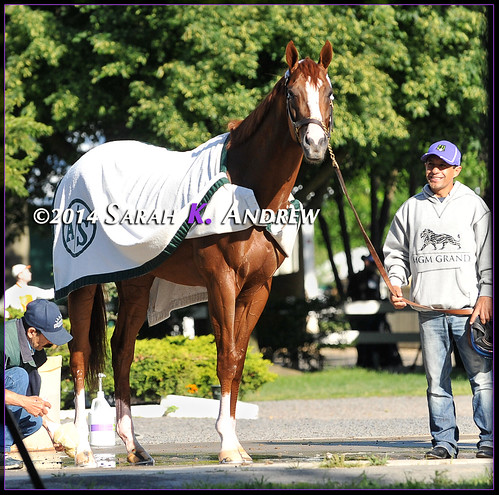
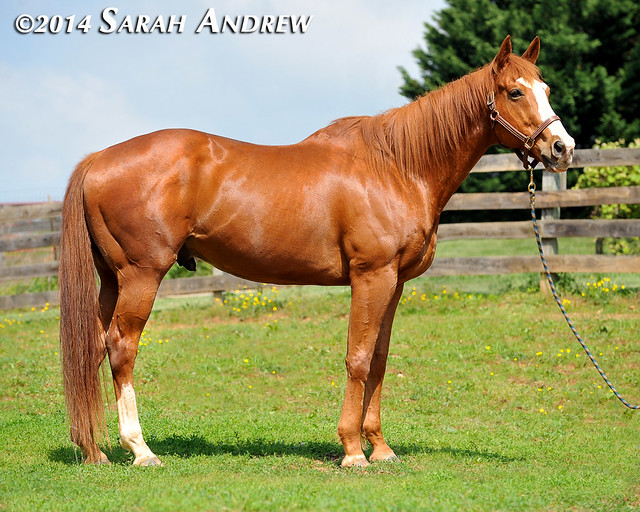
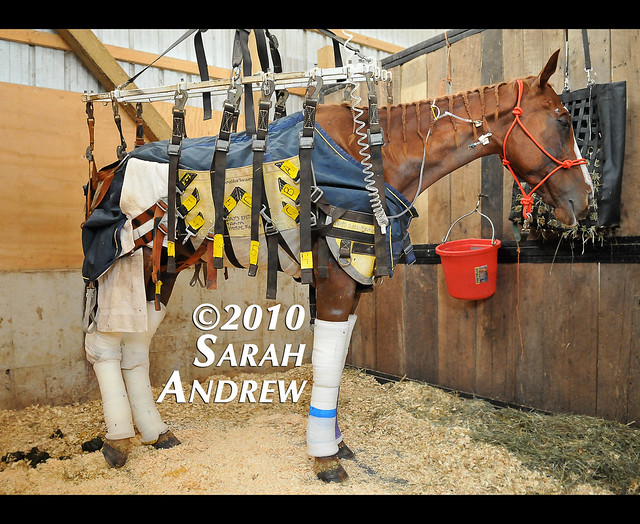
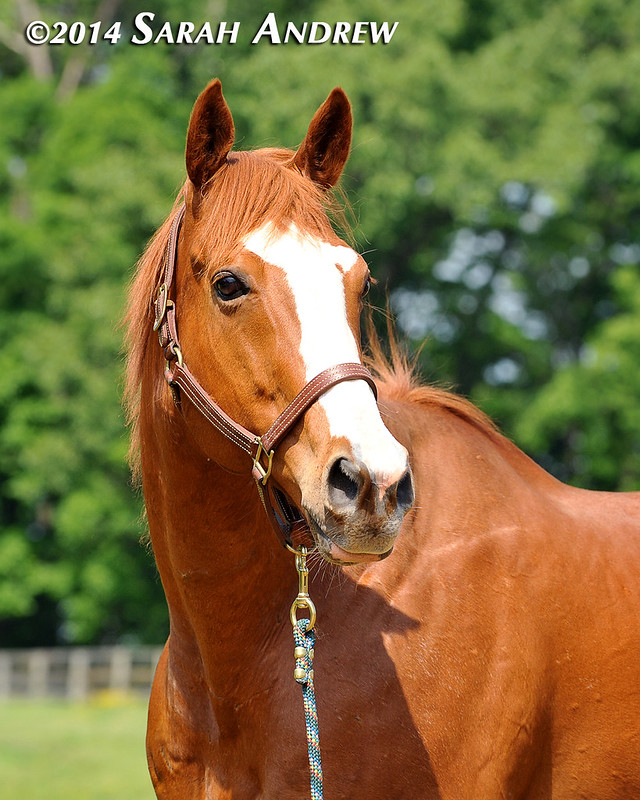
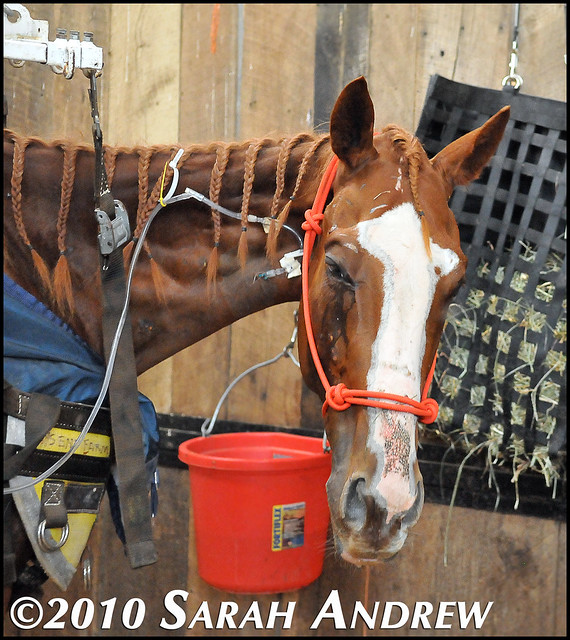
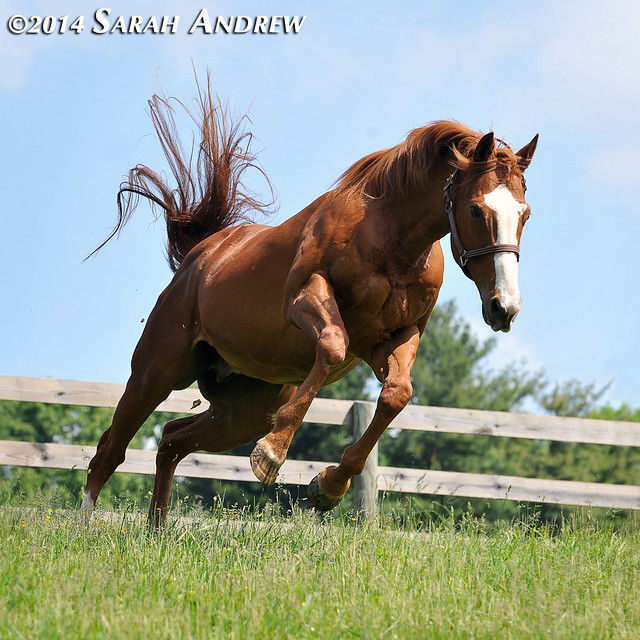
Zodiac Zar, whose incredible progress at Days End Farm Horse Rescue following a 2010 neglect case was chronicled on this blog (click here to read), moved to his adoptive home in 2012. He lives on a beautiful private farm with Willow and Classy, two mares also adopted from Days End Farm Horse Rescue.  

Two weeks ago, I had the opportunity to visit and photograph Zodiac. His expression is the same as the day I first met him, but he looks like an entirely different horse in every other way. Muscle fills his powerful frame-- he looks taller every time I see him. Gone is the tired, brittle, patchy coat-- he now glows in the sun with an iridescent sheen. 

Excellent care, a comfortable environment, companionship, and good food have brought out the best in this horse. He is thriving in every way. Success stories like his are the reason why rescues like Days End work so hard to help thousands of horses in need. Days End Farm Horse Rescue's calendar is full of fundraisers, education series, and volunteer opportunities. If you'd like to get involved, please visit the DEFHR website for more information.
Zodiac, May 2014
Zodiac in September 2010
Zodiac in 2014
Zodiac in 2010
Zodiac in 2014
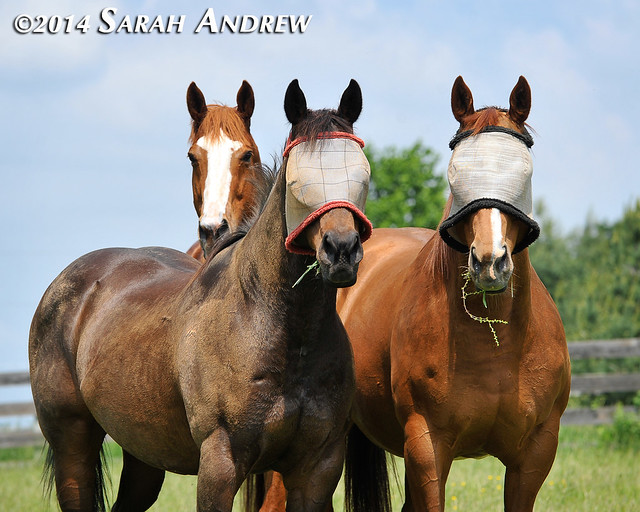
Zodiac with his mare friends, Classy and Williw
Synchronized rolling in the pasture

 Ken's Kitten 

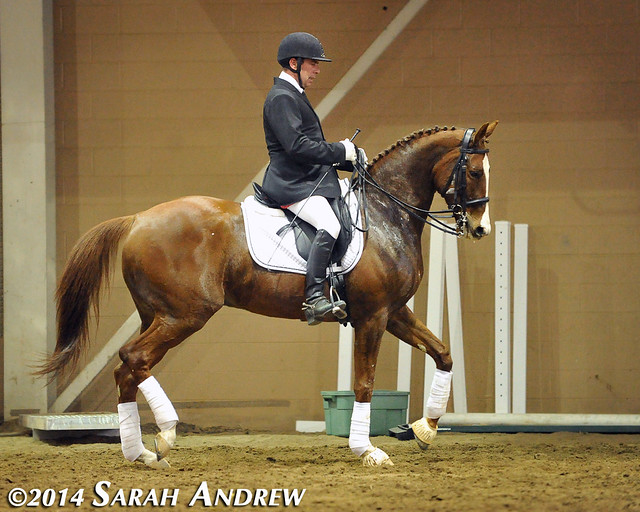
Days End Farm Horse Rescue is not the only organization with a busy schedule. Every time I check the Retired Racehorse Project's Facebook page, I learn about more events, educational resources, and fantastic Thoroughbreds for adoption/sale. On June 7, an hour or so before California Chrome is saddled for the Belmont, the RRP online auction fundraiser begins. Artwork, services, and unique experiences/opportunities will be auctioned on eBay. Trainer Nuno Santos, pictured below on his super-chromey Thoroughbred dressage superstar Ken's Kitten, donated a lesson package, and it's sure to be a hot item. Bidding ends on June 14 at the Thoroughbreds & Wine For All event at Dodon Farm in Davidsonville, Maryland. Click here for tickets.

The excitement continues on Monday, June 9, when ten trainers, horses, and racing connections will be announced for the "America's Most Wanted" contest this October at the RRP Symposium at Pimlico. Already on the roster are MSW Icabad Crane, Kentucky Derby-winning trainer Graham Motion, and Olympian Phillip Dutton. 

 
Secret Santa

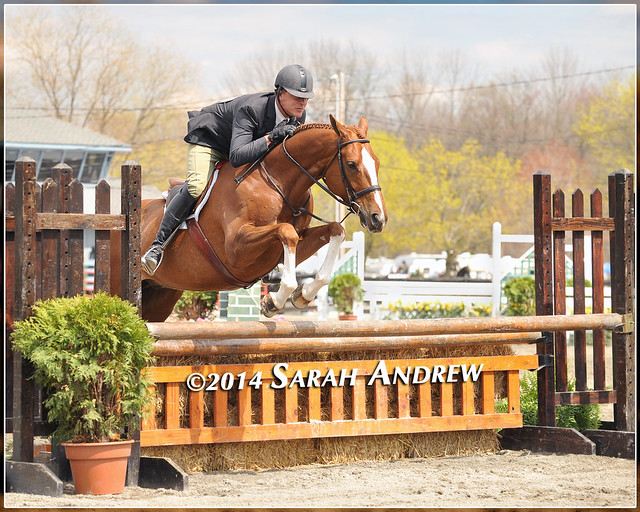
On Kentucky Derby day, Secret Santa and Jeffrey Ayers swept all four TAKE2 hunter classes at the Garden State Horse Show. The duo also cleaned up this spring in TAKE2 hunter classes in Culpeper, VA.

Since its formation in 2012, TAKE2 has worked tirelessly to promote the value of retired racehorses in the sport horse world through its hunter and jumper divisions at top horse shows. The Take the Lead program  is a valuable resource for those who are interested in retiring, retraining, rehabbing, placing, or purchasing horses off the track. The TAKE2 Facebook page is a very active showcase of both winners of TAKE2 classes and Take the Lead horses, available through outreach programs such as New Vocations.


You're in excellent company, Mr. Chrome. Best of luck on Saturday.


 - Sarah Andrew

Thursday, May 15, 2014

The Case Against 'Chrome': Handicapping the Preakness

--Brian DiDonato


Victor Espinoza celebrates aboard California Chrome
Horsephotos
   When a lower-priced horse wins the Derby, we tend to think that all the questions leading up to the first Saturday in May have been answered. Take last year, for example. Orb seemed off his Florida form like he could be the best 3-year-old in that crop, so when he won the Derby by a convincing margin, the result appeared to be definitive. Most (myself included) dismissed, or at least minimized, the fact that the Derby was run over a sloppy surface and featured a complete meltdown pace. Orb had been anointed the latest sure-thing Triple Crown winner (proud to say I don’t think I went quite that far). Then Derby also-rans Oxbow (15-1), Palice Malice (13-1) and Will Take Charge (9-1) took the Preakness, Belmont and Travers, respectively, with Orb going down at low odds each time, and things looked a whole lot less cut-and-dry.
   There is the distinct possibility of a similar phenomenon occurring this year. Yes, California Chrome had the best form coming into the Derby, and as he pulled away from his competition I thought to myself, “Okay, he’s just too good for these horses.” But then the timer didn’t stop until 2:03.66, and everyone’s figures came back slow. And then I watched the replay a few times and realized that the favorite enjoyed a dream trip in a race that was full of rough ones.
   Nothing about the Derby necessarily proved that California Chrome isn’t a stand-out in this bunch, but the same reasons that were there to play against him at 5-2 in the Derby are still there and now he's going to be 3-5 off of two weeks' rest. The pace that never materialized over a speed-friendly surface at Churchill looks like a sure thing here, and that could certainly hurt the chalk’s chances. If he wins again, you tip your cap (and triple down in the Belmont), but I’m not ready to anoint California Chrome just yet--and I'm certainly not taking 3-5 on anybody ever.
   See below for my horse-by-horse analysis.

1. Dynamic Impact - 12-1 - Certainly took a while to break out of the maiden ranks, but as soon as he did, he went on to upset the GIII Illinois Derby. It’s hard to know how much credit to give him for that effort, though. He sat a pretty dream trip just off of heavily favored Midnight Hawk, and may have benefitted more from that one’s distance and mental limitations than anything else. Still, he’s by Tiznow out of a Smart Strike mare who, though she was a sprinter, hails from a stout enough family. So the distance looks up his alley, and he could be moving in the right direction. Might just sit the trip--not completely out of this.

2. General a Rod - 15-1 - Reminds me of last year’s Preakness runner-up Itsmyluckyday, but with maybe a less advantageous style in relation to the projected pace--unless he comes from farther back like he did in the Derby, which you’d think his connections might try. His Derby trip was definitely less than perfect. He was really running late, and would have likely been maybe fifth or sixth if not for running into traffic. Still came home fourth-fastest of anyone in the race (:26.26)--behind only California Chrome (:26.21), Commanding Curve (:25.57) and Ride On Curlin (:25.73)--so there’s reason to believe he can be an effective off-the-pace threat. He’s run fast before, and is definitely one to use.

3. California Chrome - 3-5 - Already touched on him above. . . Going to try to get him out of the exacta, but certainly won’t be surprised if he wins. Then I’ll just liquidate my assets and take the Tonalist/Danza Belmont exacta box for the max.

4. Ring Weekend - 20-1 - Seems very much up against it. His front-running upset win of the GII Tampa Bay Derby seems more like the exception than the rule, especially after a disappointing showing in the Calder Derby. Then he had to miss the Derby due to a fever. Can’t envision a scenario in which he can win--his best game is using his speed, and that’s just not going to work here.

5. Bayern - 10-1 - Set a super slow pace when he won that one-mile Santa Anita allowance by 15, and regressed when third as the chalk in the nine-panel GI Arkansas Derby. Hard to love his stretch antics that led to a disqualification when dropped back to a mile for the GIII Derby Trial. Likely pace casualty who doesn’t want to go this far.

6. Ria Antonia - 30-1 - Next. . .

7. Kid Cruz - 20-1 - This is who I’m going with, though it's starting to look like he's a bit of a wise guy horse. He still hasn’t run fast enough on speed figures, but his style fits the way this race has to be run if we’re going to beat California Chrome and he’s been very visually impressive since Linda Rice claimed him for $50,000 in November. He came from out of the clouds to take Laurel’s Private Terms S. Mar. 8 over 1 1/8 miles, and looked like a legitimate GI Wood Memorial threat before having to miss that race due to a sore shoulder. Seemingly no worse for wear, the Linda Rice trainee flew home again into a slow pace to take this venue’s Federico Tesio S. last time Apr. 19. A win over the strip can’t be a bad thing, and the distance shouldn’t be a problem. He still needs to prove he’s good enough, but he has upside and should get the right set-up.

8. Social Inclusion - 5-1 - Possibly the toughest read in the race. He’s shown just about as much talent as any 3-year-old this year, and it’s easy to excuse his tough-trip third in the Wood--he was wide, pressing a hot pace and still looked like the winner until very late. But isn’t he going to run into the same problem here? His connections seem to think his best chance is to try and run these horses off their feet--and maybe they’re right or at least they’re aware that Social Inclusion doesn’t want to rate--but they’re going to have to hope that all the other speeds decide not to send for that strategy to work. Not tossing out completely, as I think it’s hard to deny his talent and could see him winning a race like the Haskell later on this year, but fear he might be up against it again this time.

9. Pablo Del Monte - 20-1 - Seems very likely that he’s a better synthetic horse and doesn’t seem to want this trip. Adds more fuel to the fire.

10. Ride On Curlin - 10-1 - Somewhere between on the lead and dead last early is where he wants to be, but anyone who was surprised with Borel taking him back to last in the Derby just doesn’t pay attention. It may have actually been his best bet considering the potential there for a collapse, but the pace just didn’t quite materialize and he still ran on well to be seventh. He finished faster (:25.73) than everyone but Commanding Curve, and just needs to work out a trip one of these days.

The play: Win bet on Kid Cruz and an exacta box of Kid Cruz, Ride On Curlin, General a Rod and Dynamic Impact. Will also play a Social Inclusion over Kid Cruz exacta saver and will probably use the four from the exacta box, plus Social Inclusion and California Chrome in the pick four if I decide to play one on a somewhat uninspiring undercard.

Kid Cruz draws off in Pimlico's Federico Tesio S.
Jim McCue, Maryland Jockey Club

Black-Eyed Susan Day Analysis

--Brian DiDonato

PIM 7 - Rollicking S. - It’s like the Wesley Ward Futurity. . . The 2-year-old specialist has half of the eight runners entered in this very early juvenile stakes race (maybe he’ll scratch one or two? I hope not.) One of the most important things I look for in these races is the length of time between now and the horse’s debut or most recent start. These very precocious babies are usually fully cranked to win first out, and the more time they have to recover after their debut, the better. Debt Ceiling, for example, the 5-1 winner of this event last year, debuted so early (Mar. 30) that he already had a lay-off line coming into this race. The two runners I like happen to be tied for most time off between starts, and are also both trained by Ward. Hootenanny assumed the role of the “other Ward” when he was let go at nearly 5-1 for his Apr. 17 Keeneland unveiling, only to best 2-1 stablemate and return runner-up Circle the World by an easy 4 1/4 lengths. I thought he did it the right way, and he looks like he can switch off and rate--something he’ll be well-served to do here. Hootenanny also had a very sparing worktab coming into his debut, so perhaps he’ll move forward off that effort. The other Ward horse I’m interested in--and the one I’ll be betting to win--is Bessie’s Boy. Shipped here for his debut Apr. 17, the 3-5 favorite chased the pace well out into the track and ultimately prevailed over the re-opposing pair of Pret Say Eye and Governmentshutdown. The latter returned to romp here May 3 with a field’s-best 82 Beyer, which flatters Bessie’s Boy, but makes me very dubious of Governmentshutdown’s likelihood of replicating his best while making his third start in a month. I also like that Bessie’s Boy received a relatively low 51 Beyer for his debut, as early juvenile figures reveal very little in terms of actual ability, and lower figures often mean more is left in the tank while inflating the odds (Beyers, of course, are not produced for Keeneland’s 4 1/2-furlong races because of the configuration used, but I’m pretty sure the Keeneland winners here would have earned higher than a 51 on the Beyer scale.) Play: Win on #5 Bessie’s Boy (10-1), exacta box with #6 Hootenanny (5-2).

Joint Return                                            Joe Labozzetta

PIM 10 - GII Black-Eyed Susan S. - She may be too slow, both in terms of pace and final time, but I have to give Joint Return one more shot to handle tougher competition. The John Servis trainee first caught my eye with two wins at Parx in which she overcame very slow paces to blow by her competition with ease. Let go at 7-1 for Aqueduct’s Feb. 1 Busher S., the dark bay again mounted a head-turning bid, inhaling her competition in last-to-first fashion while covering plenty of ground (albeit against a pretty average group). I was sold on Joint Return as a legitimate Oaks contender at that point, but she never lifted a hoof when fifth in the GII Gulfstream Park Oaks Mar. 29. I am willing to excuse that effort, however, as we’ve seen plenty of recent examples of closers simply not taking to the speed-friendly Gulfstream main track this year. Dropped in class for the Apr. 12 Calder Oaks, Joint Return was back to her old self, looking like she might be eased early before cruising by every one of her foes like they were standing still. While the first quarter of that race was very quick, the frontrunners really slowed it down after that and still ran second and third, so it seems Joint Return’s performance was reasonably legitimate (again, not the strongest competition). She earned a career-best 76 Beyer, which is by no means quick, but there really aren’t any fast fillies in this race (average Beyer top for the rest of the field is just 81.2), and as a deep closer, she’s never going to really run a fast number unless she gets a hot pace. I’m not expecting exceedingly quick early splits here, but Joint Return shouldn’t be at a disadvantage and she still has every right to be much better than she looks on paper. Play: Win on #1 Joint Return (15-1), also using #2 America (8-1), #8 Sloane Square (5-1) and #9 Fortune Pearl (12-1) in pick threes.

PIM 11 - Miss Preakness S.  - Here I go right back to a slow-looking John Servis runner. Stormy Novel is basically Joint Return with the added positive of a cut-back in distance. She was very visually impressive taking a Parx allowance Feb. 2 at 1-9 odds, but faded to sixth after setting the pace in Turfway’s GIII Bourbonette Oaks over a mile of Polytrack. Being by Bernardini, one might think she should prefer going long, but there’s plenty of evidence to suggest that she’s back at a more suitable distance. Her speedy, but 0-for-2 dam is by Forestry, and also produced Stormy Novel’s full-sister Bridgehampton, who was second in the GIII Victory Ride S. last June and who has never been sent beyond six panels in five career tries. If the morning line on her holds, 8-1 shot Miss Behaviour will also be a significant overlay. Her dirt sprint form was extremely solid at two, and she would have beaten Miss Preakness entrant Tea Time in last October’s Sharp Cat S. if that filly hand’t been allowed to set a laughably glacial pace. Miss Behaviour’s two most recent races came going a mile and over turf, respectively, but this is her game and I look for her to run big. I’ll also toss in 2-for-2 Our Lesmis, whose win in the mud last time is a positive considering the very wet forecast for Friday. Chalkier horses Jojo Warrior and Tepin should also be respected, but I’ll only use them as back-ups. Play: Win on #1 Stormy Novel (15-1), exacta box with #4 Miss Behaviour (8-1) and #5 Our Lesmis (5-1). Using those three in pick threes as well as #8 Jojo Warrior (5-2) and #6 Tepin (9-2) as back-ups.

PIM 12 - GIII Pimlico Special H. - I don’t have any particularly strong opinions here, but it’s nice to see this once-prestigious race attract a competitive field. Morning-line choice Revolutionary feels like he should be pretty tough if he shows up with his best--he had that traffic trouble thanks to Will Take Charge in the GII Oaklawn H., and more ground plus a potentially wet track both play to his advantage. If there’s an upset, I think it’ll come from either Revolutionary’s stablemate Golden Lad or Prayer for Relief. Golden Lad was clearly already beaten when he was bumped in Arkansas, but he seemed washed out and maybe not on his game before that race. He was on an upward trajectory before that, and earned a career-best 102 Beyer two back over a wet/fast track in Oaklawn’s GIII Razorback H. Mar. 15. I’ve never been a big fan of Prayer for Relief, to be honest, but he does have some fast races that stack up well with these and I didn’t like the ride he got last time in his first start switching from Steve Asmussen to Dale Romans. He was left out unnecessarily wide early, dropped back like he was done on the turn, but re-rallied in the stretch to finish only 2 1/4 lengths behind Revolutionary. If Oaklawn had Trakus, I would think the ground loss adjustments would put Prayer for Relief ahead of Revolutionary. If he goes off at or above his 12-1 morning line, he’s probably worth a small win bet. Play: Odds-dependent win bet on #8 Prayer for Relief (12-1). Using him, #6 Revolutionary (5-2) and #4 Golden Lad (6-1) in pick threes.

Friday, May 2, 2014

Derby Undercard Analysis

--Brian DiDonato

CD Race 3 - MSW, 6f - There are some very telling stats for trainer Ian Wilkes that make #10 Boss Gone (8-1) pretty much an automatic bet here. The gelding was sixth with a fairly rough trip on debut over the Keeneland Polytrack Apr. 12, and is likely to improve drastically under these conditions. For one, according to DRF Formulator, Wilkes is just 7% on synthetic tracks (5% at Keeneland) over the past five years; and only 2% with his first timers. Combining those two categories, he’s 0-for-29. Wilkes does much better second out, however—especially recently. He’s 7-for-30 (23%) with maiden second timers over the past 12 months with a very strong $3.70 ROI, and an even-better 6-for-22 (27%) with a $4.83 ROI when that stat is restricted to dirt starters. There’s plenty of speed signed on here, and Boss Gone actually fits pretty well on speed figures. Maybe that means the 8-1 morning line quote is unrealistic, but regardless, I’m expecting a much-improved performance from this Wilkes trainee and think anything around 9-2 or better is fair value.

CD Race 6 - GII Distaff Turf Mile - Centre Court is a very worthy favorite with a three-for-three record over the Churchill strip, but #6 I’m Already Sexy (10-1) has a chance to spring the upset. The Wayne Catalano pupil put together a pair of solid winning efforts over the Arlington turf course this summer, including a 3 3/4-length victory in the GIII Pucker Up S., but was up against it in her last two trips to the post as a sophomore. She failed to make the lead when drawn wide in a very quick-paced renewal of the GI QE II Challenge Cup, and had a similar problem in this venue’s GII Mrs. Revere S. over good ground. There isn’t really much speed signed on here, however, and if I’m Already Sexy is gunned to the lead, she could get brave over a one-mile distance that should be to her liking.

CD Race 8 - GII American Turf S. - I’ll spread pretty wide in here to kick off the pick four, but I’m most interested in #2 Chief Barker (5-1). I know, surprise, surprise, I’m picking the Euro. . . But he kicked off his career with three well-rated victories in Britain last Summer, including a score over the ill-fated Chriselliam. She annexed the G1 Fillies’ Mile and GI Breeders’ Cup Juvenile Fillies Turf in her next two outings. Chief Barker hasn’t been seen since finishing sixth in the G1 Racing Post Trophy for Richard Hannon, but it didn’t look like he loved the soft ground that day and he appears to be working very well for new conditioner Larry Rivelli. This is the type of horse that gets more lost on days when there’s more casual money in the pools.

CD Race 9 - GII Churchill Downs S. - This is another race with a number of possibilities and live prices, but I have to go back to #2 Clearly Now (9-2). I loved him in the Carter (analysis here), and obviously wasn’t alone as he went off the 5-2 favorite, but could only manage third. He got a really terrible ride in a race full of bad rides--I’ve never seen a Grade I sprint run like a 12-furlong turf race before, but that’s pretty much what happened. Anyway, Clearly Now should have been right up there pressing the pace instead of being strangled in and among horses--now he gets a rider change to Javier Castellano, who’s never afraid to put his horses into the mix early. The lay-off was the main concern for Clearly last time, as he always seems to fire best second off the bench, and he should be ready for a peak effort here.