Showing posts with label TRF. Show all posts

Tuesday, July 5, 2011

Book Review: 'Handicapping On the Road' by Mark Cramer

--Brian DiDonato

Renowned horse racing author Mark Cramer's Handicapping on the Road is an important and interesting addition to several genres within racing literature. Last year, in an effort to raise funds and awareness for Thoroughbred retirement ($1.50 from the sale of each book goes directly to the TRF), Cramer and fellow horseplayer Alan Kennedy (both Americans living in Paris) took a 1,000-kilometer bicycle tour of French racetracks, attempting to pay their expenses in full with winning wagers. They succeeded on both fronts, and Cramer entertainingly chronicles the entire adventure while presenting readers with a number of useful angles and handicapping insights.

Cramer, perhaps best known for the contrarian methods outlined in his 1993 work Kinky Handicapping, relies on different factors than most other horseplayers. Always in search of the "automatic bet," many of his plays are determined before entries are even drawn--he thoroughly researches and identifies particular angles or situations which have proven profitable over a significant sample size, and simply waits for those betting opportunities to present themselves (Cramer does, however, adjust his plays based on more "traditional" handicapping techniques). The author explains, "Classical handicapping and statistical handicapping are equally valid for picking winners. However, the betting public practices classical analysis much more than statistical handicapping, so the average odds for classical choices are lower than for statistical choices." Cramer weeds out, for the most part, the human, subjective elements of horseplaying and is left with all that really matters in terms of profit--the stats.

Handicapping on the Road is structured in a way that mirrors Cramer's own methodologies. The first part of the book lays the foundation, discussing both the fundamental principles underlying his techniques and presenting examples and particular angles, while the second half follows the author and his companion along the roads of France and from track to track. By the author's own admission, the first half of his work is more geared towards serious handicappers--it's a bit dense and may not be of interest to everyone. But to those serious players, it's a must-read.

One of the most illuminating elements of the handicapping-centric first section of the book comes from Cramer's interesting perspective on the differences between handicapping American races and European ones. His methods are very American, but have been adapted successfully to the different considerations present in races abroad--this not only gives those employing Cramer's methods an edge when playing foreign races, but provides a deeper understanding of dynamics at play in races on both sides of the pond. The author goes as far as to argue that, "From Dubai to France, and virtually everywhere else in the world, American handicappers can often find an even greater edge than back home."

The insights offered by Cramer are most useful to American readers/bettors for comparing North American and foreign form when the two overlap, namely in the Breeders' Cup, Arlington Million, major turf races at Woodbine, the Dubai International Racing Carnival and at Royal Ascot--or any time a European horse resurfaces stateside. The intersection of Internationally diverse influences can also be less pronounced; while following results from Royal Ascot and other European venues recently, I couldn't help but wonder if Cramer was cashing in on one of his angles that involves American-breds running in Europe. If he was betting the races in question, he was certainly making money. Cramer also presents readers with an excellent primer on trainer angles--an increasingly popular and important handicapping factor. His focus is on European trainers, which is useful in its specificity, but all concepts can be easily translated to American racing.

The second half of Handicapping on the Road features a noticeable change in writing style. Cramer, who also penned the well-received works of fiction Scared Money and Tropical Downs, allows his humorous, somewhat sarcastic style to shine through in a way that it cannot in the first section due to the nature of the subject matter. Whereas the first half of the text has a limited target audience, the second half will appeal to anyone interested in a number of broader topics.

Presented as a travel log, it's reminiscent of Beyer's excellent My $50,000 Year at the Races, but with a much more exotic back-drop. Stage by stage, Cramer discusses his surroundings--both inside and outside of the track--offering up interesting information for those wanting to familiarize themselves not only with the larger tracks in France, but the smaller rural venues--and with French life in general. The author, of course, places wagers along the way that are based on the groundwork from section one, allowing for a real-life glimpse into the considerations and actions taken by a horseplayer of Cramer's ilk. While this section is not as heavy on the handicapping, readers are given shorter explanations of the author's methods, serving to re-enforce ideas for those who read part one and fill those in who did not. Cramer does well in his aim to entertain and engage both groups.

Handicapping on the Road is an excellent read for the serious horseplayer, but also has much to offer for those who do not wager regularly. With its underlying concern for the good of the horse, it is a worthwhile addition to the library of both the horseplayer and horse lover.

Wednesday, April 27, 2011

HANDICAPPING ON THE ROAD

--Sue Finley

Early last spring, I was forwarded an email from an American man living in Paris who wanted to somehow combine handicapping and bicycle riding to raise money for retired thoroughbred racehorses.

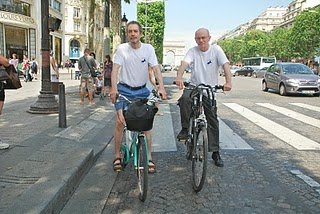
The man, Alan Kennedy, said he had a friend, Mark Cramer, an author and bicyle enthusiast who had published both handicapping books and novels and who wanted to try out some of his methods at French racetracks, which he would reach by bicycle. Kennedy was going to accomplany him.

At the time, I was the first vice president of the Thoroughbred Retirement Foundation. My principle occupation for them was fundraising, and since it was a rare day when someone showed up and asked if they could help you raise money, I quickly said, `yes, thank you.’

Kennedy and Cramer prepare for their journey in Paris
Mark and Alan’s idea was that they would pedal a few hundred kilometers for the cause. What they didn’t know was that I may well be the world’s biggest Tour de France fan. I spend three weeks every July glued to the Versus network, catching the 8 a.m. preview, 8:30 - 11 a.m. live coverage, 2-5 p.m. recap and then the 8-11 p.m. recap...which is pretty much exactly like the 2-5 recap. I’m a little obsessed.

So I said, “You know what would really be the thing? To ride this tour during the dates of the real Tour de France, from July 3 to July 25. You could go from track to track in 21 stages, just like the riders go from town to town. People could pledge money per mile, or just make general donations.” They clearly thought I was crazy, but were also intrigued by the challenge, and wanted to do some good.

We decided that they could blog about it as they rode, and I would link the blog to a personal fundraising page that I would promote in the TDN. Putting aside fears of heart attack, heat stroke and general breakdown, they agreed to do it.

The result of this journey (aside from the thousands of dollars he raised for the TRF and a similar organization in France, La Ligue Pour la Protection de Cheval) is Cramer’s fantastic new book, Handicapping On the Road: Two men, 65 and 59, bicycle 1,000 kilometers to 13 race tracks to save discarded Thoroughbreds, testing seven exciting betting methods along the way.

The book is divided into two sections; the first, on the handicapping methods he features, and the second on the travelogue aspect and real-life betting stories of the trip. (Spoiler: he paid for the entire trip with his winning bets.)

Mark at Longchamp
The forward to the book is inspiring. Writes Cramer, “Using animals for entertainment and then sending them off to slaughter seemed as much an attack on our own humanity as it was the ultimate abuse of animals...Race fans feel rightful outrage and deep sadness when an equine athlete breaks down on the track. That’s because we see when it happens. But no one sees what happens to hard-knocking working-class Thoroughbreds when they disappear from the barns.”

The finish line at Compiegne
Cramer’s handicapping books are some of the most highly acclaimed in the industry. It has been a personal honor to come to know him and Alan, and I look forward to seeing them both in France this July, when we can watch the daily Tour coverage together over a nice glass of Bordeaux.

In the meantime, I highly recommend Handicapping on the Road, available here:
http://www.altiplanopublications.com/ontheroad.htm

Thursday, March 31, 2011

The Retirement `Solution'

--Sue Finley

Over the past two weeks, dozens of people have called, emailed or come to talk to me about the New York Times story on the Thoroughbred Retirement Foundation. As most of you are aware, I was on the board of the TRF for 12 years. As some of you may not know, I left the board last August for reasons which included differences of opinion with some board members, lack of time, and simple charity fatigue. After begging people for years to support this cause, I was simply worn out.

That doesn’t mean I don’t still support the cause, or don’t support the TRF, or don’t think you should still give your money to them. I do, on all counts. While I’m going to leave much of their own defense to the organization itself, as I have not been on the board for seven months now and am no longer versed in the daily goings-on, I will say that I’m pretty confident nobody at the TRF was starving horses for lack of money. They’re an incredibly dedicated bunch of individuals who have taken up a cause nobody else cared to do. If I had to guess, I’d say that it’s difficult to maintain hundreds of mostly 20-year-old racehorses over a long, hard winter, and that it’s impossible to expect that they’re all going to thrive out in a herd. Should some of them have been put down last fall? Probably. Is it hard for a ridiculously understaffed, underfunded organization to know that everyone on 13 farms is making the exact same decisions at every moment that they would make if they were there? I would imagine so. Did they make some mistakes? Absolutely.

Were they starving the horses for lack of funds? In no way do I believe that’s what has happened.

But the most troubling aspect of all this to me is people--good people, smart people, caring people–most likely overwhelmed when they look at the scope of the issue, are now suggesting a `solution’–that we should just humanely euthanize them at the end of their racing days if we can’t get them privately adopted. This isn’t a new theme--I’ve been hearing it for years–but it has grown in popularity of late.

It’s the only solution, they tell me. It’s humane, and it’s simple, and it solves the problem.

To anyone who thinks that’s a solution, I’d like you to do a little exercise. Think back to the first time you ever went to a racetrack. Maybe you were five, or 10, and your parents took you to Keeneland or Belmont or Newmarket (or Suffolk Downs, if you were me.) I know what I remember, and what attracted me to the sport. It was the horses. They were big and beautiful; majestic and inspiring creatures. I ascribed personalities to them (that they may or may not have had) and felt every bit as bad when they had setbacks as I did when the Red Sox lost to the Yankees. If I had asked someone then what happened to the horses when they were done racing, and they had said, “Well, we kill them...but we do it humanely,” I would have run screaming from the building, never to return, as I imagine you would have done.

So if you can’t admit to the world what your athletes’ pension plan is and be proud of it, I’m pretty sure this isn’t the retirement `solution’ racing needs to pursue. If we don’t want racing’s slogan to be, `the best cared-for and loved animals on the planet...until we don’t need them any more, at which time we kill them,’ let’s all aspire to better.

This can’t be left to charity any more. It’s time for an industry wide institutional funding mechanism that we can shout from the rooftops about. Because I’m pretty sure that if we can’t shout about it, there’s something wrong with it.

It’s time for all of the constituents in racing to sit down at the table and agree upon who is going to contribute what percentage from every mount, every start, every foal, every sale, every claim.

If you think we can’t afford it, you’re fooling yourselves.

We can’t afford not to.

Friday, March 25, 2011

GOOD...AND GOOD BUSINESS

Since arriving in Dubai, I have encountered a lot of people who want to chat with me, or learn more about the reaction in America to the New York Times story last Friday about horse retirement. Over the course of the past 10 years, I have thought a lot about, and given a lot of time to this issue, specifically to raise money for the Thoroughbred Retirement Foundation, the charity that was called into question in the article. I have given my time because I think their work is necessary. I think that their prison programs have been an incredibly compelling story, and have been very good news for the racing industry. Not only has it created good feelings about thoroughbred racing, but it has been a model of what good racing can do, particularly when the sport is under attack. I have always felt that these programs separated them from the pack of other rescue organizations--all of which do good and important work. Additionally, my publishing partner, Sue Finley, served on the board for 12 years, and I knew it was important to her and I wanted to support her.

TRF Retiree The Optimist, (c) trfinc.org
Over the past week, the issue has gone from something that it was nice to participate in as individuals, to something we need to do something about as a sport.

If we don't, I believe our entire industry is in jeopardy. I don't think we can trust that the positive attributes of Thoroughbred racing (whatever that means to each of us as individuals) will always be able to overcome the question that will be posed to our most prominent participants as they head for the Derby, run in the Breeders' Cup or maybe accept an Emmy. That question is: "Hey, you love Thoroughbred racing. Why does the industry allow its participants to be killed?"

In today's world of instant communication, I don't think we have the ability of controlling the message without solving the problem.

It has now become a mandatory thing if we want to stay in business.

--Barry Weisbord