Showing posts with label Sue Finley. Show all posts

Monday, August 6, 2012

Taking One for the Team: Trying out the Kiwi Collection

by Sue Finley

Several TDN readers have commented to me about the ads we have been running for the Kiwi Collection, offering our readers "2,500 hand-picked hotels in 135 countries."

"What's that all about?" they have asked. "How are the hotels? Are they owned by one company? Are the deals reallly that good?"

The Cliff House at Pikes Peak — Manitou Springs, United States
The Cliff House at Pike's Peak
It was a tough assignment to volunteer to find out, but, in a massive bout of self-sacrifice, I decided to do a little research and offered to go stay in one of these fine establishments in order to provide more information for our TDN clients. Not that I wanted to, mind you. But I'm all about the company.

As my family is in Colorado, and I had a visit planned, I looked to see what hotels the Kiwi Collection offered in the state on their handy booking widget, which is found here on the TDN website: (http://www.thoroughbreddailynews.com/members/collection/kiwi-widget.cfm). A search for Colorado found 24 options, most of them ski resorts, but two of which caught my eye: the Broadmoor in Colorado Springs, and The Cliff House in nearby Manitou Springs. We had planned a trek up Pike's Peak, so chose The Cliff House for its proximity (and for the fact that Travel and Leisure called it one of the top 100 hotels in the world.) Again, I was willing to make the sacrifice for our readers.

I rented one room for myself and two kids, and another for my 85-year-old aunt and uncle, who live in Estes Park, a few hours away.

The view from Pike's Peak, where you're literally up in the clouds.
I originally booked the vacation for the end of June, and watched the growing wildfires with some concerns, as they were located primarily in the Waldo Canyon, just west of the hotel. On June 23, I had a call from my uncle that his neighborhood in Estes Park was on fire. I called the hotel, and they said that while they were open, all of the attractions in the area were officially closed, and very graciously offered to rebook our stay for one month down the road. First experience with them: high marks.

The NY Attorney General told the TRF that the Colorado
Springs area wasn't suitable land for horses...but we saw
hundreds like these, and they all seemed pretty happy.
We arrived at the hotel last Tuesday. Manitou Springs is a touristy town, with one main street lined with the sorts of shops you'd expect (Indian curios, fudge shops, t-shirt stores, an arcade, etc.) and a series of mid-priced motels just outside of downtown. (The last time I was in Manitou, I stayed at one of these motels, where I watched my daughter's hair turn a vivid green after a swim in the pool. We were looking for something slightly more upscale this time.)

Tucked one block off the main road, however, The Cliff House may as well be on a different planet. Most closely resembling a huge Victorian home, it has a distinctive Saratoga feel to it, for good reason.

Sarah Finley feeds a giraffe at the Cheyenne Mountain Zoo.
Originally built in 1873, The Cliff House was an inn on a stagecoach stop from Colorado Springs to Leadville, one of the most famous stagecoach runs in the American West. When the gold strikes in the region started to dwindle out, the town found its resurgence in its mineral springs, which, like Saratoga, were thought to have recuperative properties. The hotel was reborn as a destination for the wealthy, and expanded to the 54-guest-room structure it remains today, with guests encouraged to stroll downtown to the public Soda Springs on the main street for a glass of spring water. We gave it a try, and it tastes remarkably like Saratoga's--slightly fizzy, slightly salty, and with just a touch of sulpher.

The junior suite.
The highlights: drinks and dinner on the Veranda--a deep, Victorian porch decorated with wicker furniture--was so good the first night, we did it again the next, starting with their great wine list in late afternoon, and moving seamlessly into dinner. The late-night menu prices are ridiculous, with good-sized entrees like fish and chips starting at $6. There's an extensive kids' menu, and an ever-changing vegetarian menu, from which I dined both nights.

The rooms are not huge, but are sumptuous, with multi-head showers with steam, free wifi, hundreds of channels, and a DVD library with 300 titles to borrow. They wouldn't allow three people in a standard room, so we upgraded to the junior suite. Again, I'm all about the sacrifice. Pillow-top beds, 400 thread count, and dead-quiet rooms ensure a good night's sleep. Each room has a mini-fridge, and stocks it with free bottles of water to ward off elevation sickness. At 8,000 feet above sea level, being in Manitou Springs is like being on a plane, 24/7, complete with the dehydration that accompanies it. As most of the guests will travel up Pike's Peak, to 14,110 feet, staying hydrated is a must.

The Pike's Peak cog railway bring thousands of visitors
a year to the summit.
Area attractions are plentiful. We took the cog railway to the top of Pike's Peak, where the temperature was 80 in Manitou Springs, and 45 and hailing at the top. The views are unforgettable, and the tour guide knowledgeable and funny on the ride up and down. A nearby wolf sanctuary was a hit with the kids, and the Broadmoor down in Colorado Springs organizes trail rides up into the hills. Whitewater rapid trips can be arranged for both the fearful and the brave. A slew of zoos, museums, natural beauty, cave and mining tours are in the area. Don't miss a drive through the Garden of the Gods for some of the most awe-inspiring rock formations you have ever seen. We visited the Olympic Training Center, where our Olympic athlete bobsledder tour guide was the only athlete left in the village, the others having gone to compete in London.

Everything has re-opened since the fire, but the damage is quite visible outside of town, and a sudden heavy rain sends dirt sliding onto the the main road, which is quickly cleaned up by crews. But the fires never quite reached town, and after two days at The Cliff House, I find myself immensely grateful the beautiful old hotel was spared.

The best part? By booking through the Kiwi Collection, our double room was $110, and the suite $170--an absolute steal for one of the world's top 100 hotels.

But come to think of it...I think I'd better try out another Kiwi Collection hotel. Say...Turks and Caicos? February?

Tuesday, April 10, 2012

The New Generation: Why My Son Doesn't Like Horseracing


   Last week, during our school's spring break, I took my son to Seattle to visit the Boeing airplane factory. My son is a bit of an aviation junkie, and going to an airport or on a plane with him generally provokes discussion that goes like this:

Ryan: "Mom, do you see that 737-800 over there?"
Me: "The US Airways plane, right there?"
Ryan: "Oh, my god, Mom. That's an Airbus A-319."
Me: "How can you tell?"
Ryan: "How can you tell? It's a completely different style of engineering. Do you see how the wingtips on the 737 are advanced blended winglets? They reduce lift-induced drag and are now available as a standard production line option for all 737s, except of course, for the 600 series, where they're still assessing the applicability."
Boeing's 737 wingtips in the foreground in red are clearly
different from those on the Airbus 319 (in yellow).
Me: "Oh."
Ryan: "The A-319s have wingtip fences. And of course, the new Boeing 747-8i and 8f, as well as the 787-8 and 787-9 have raked wingtips."
Me: "Of course."

   Ryan is 13.
   So, for five days, we spent every minute of every day trolling through a half-dozen museums dedicated to aviation history. We hit the Heritage of Flight collection, where Ryan showed me the oh-so-obvious difference between the B-25 Mitchell and B-26 Marauder (which happened to be the plane that bombed my father's POW train during World War II in a friendly fire incident). It had something to do with two side thingees on the tail...and a 75 millimeter cannon...I think.
Ryan Finley heaven: watching Air France executives
inspect their new 787 at the Boeing factory. Or maybe
it was a 777. (I can't tell the difference, but don't tell Ryan.)

    We saw the Future of Flight center, where we designed our own aircraft; went to the Museum of Flight, where we climbed aboard the original Air Force One; and took the Boeing factory tour twice, where there's some chance Ryan knew as much if not more than the tour guide. No sooner would he whisper to me, "the composite material in the 787 allows for greater humidity in the cabin," than the tour guide would say to the group, "the composite material in the 787 allows for greater humidity in the cabin."
   When I called friends at home to report all of this, one friend said to me, "I wish I had spent my youth being obsessed with something productive like aviation, instead of horses."
    And it made me start to wonder...why isn't Ryan obsessed with horses? It's certainly not his upbringing. He has been to the Haskell and the Breeders' Cup, to our box at Monmouth, to horse farms to see mares and foals, and the retired racehorse we sponsor.
   Had my parents taken me to Seattle when I was 13, I would have coaxed them into taking me to Hastings Park, where I would have obsessed over Kenny Skinner's ROI on the turf, compared to his dirt stats. When I was a kid, we used to go to Hialeah on spring break.
   Furthermore, Ryan is an animal lover, as I was as a child. He participates in the family's dog rescue efforts,  and can't bear to watch any film in which an animal might be harmed. I had to promise him that Secretariat would make it through a whole career unscathed, as would all of his competitors, before we could go see that film.
   And the sad realization I have come to is that racing, for many reasons, no longer feels like a sport that attracts the animal lover, as it did when I was a child. As a teen, I would wander around Belmont, looking at the huge, beautiful posters comparing the Thoroughbred racehorse to the cheetah. "Hay, oats and water" was a gigantic selling point to someone like me, one which I continued to use through my days as a NYRA PR flack to assure visiting media that the people in New York cared for horses like nowhere on earth.
   Today, I'd have a hard time justifying raceday medication to my son. I'd have a hard time explaining why jockeys whip the horses if they love them so much. I'd have a hard time telling him that with a national catastrophic breakdown rate of 1.91 per 1,000 starts (about double what it was at NYRA when I was a teenager), that statistically, every 12 days he would see a horse break down and die on the track, but that it was part of the game. I know he'd feel if that happened, and I know I'd have no answer for him.
   There is a whole generation of Ryan Finleys out there, more sensitive to animal suffering than we ever were. As parents, we'd prefer to say to them that horses don't run when they don't feel up to it, and they only run as fast as they're able without being hit to run faster, and that everything is being done to make sure they don't get hurt. But in our hearts, we really can't.
   We're spending a lot of money right now as an industry to market our product to people who might not know about it. But really, some of us know a lot about it, and aren't finding enough to recommend about it, which leads me to believe that we don't have a marketing problem; we have a product problem.
   If we're not willing to take a hard look at fixing it, we're going to let a whole generation of Ryan Finleys grow up being obsessed about something else.

Thursday, September 8, 2011

The Perfect Horse

--Sue Finley

Yesterday, Airdrie Stud announced that they were pensioning Slew City Slew. Many will recall him as the sire of 54 black type winners, or as a two-time Grade I winner, or the sire of Lava Man. But 25 years ago, he meant the world to me for entirely different reasons.

I was a terrible hotwalker. Really, truly terrible. My `real’ job was working in the NYRA press office, where I had been hired my senior year in college in 1984. Somewhere along the line, it occurred to me that if I were going to promote racing, I really should understand it not just from the fan’s perspective, or from the company’s perspective, but from the backside perspective as well.

Being the mid-eighties, I had interviewed Woody Stephens about a million times during my first year or so of the job. He was not only in the middle of his incredible run of five consecutive Belmonts, but had assembled some of the most amazing equine talent and pedigrees in history. It seemed like a great opportunity to learn about horse care and training from one of the true legends of the sport. So, one day, during the spring of 1985, I tentatively asked him if I could maybe walk hots for him a couple of days a week. He said that pay day was Friday, and that some of the hotwalkers would go out and get drunk Friday night and not show up for work on Saturday, so if I wanted a job on weekends, it was mine, as he could use the extra help. Simple as that, and I was in.

The legendary Woody Stephens
The pay was $25 a day, or about $41 per weekend, after taxes. I was taking home $160 a week at the time for NYRA, so this was a serious boost to my finances. Now, after my rent, car and student loans were paid, I would now actually be able to afford dinner, if not every day, at least sometimes.

Woody had two barns back then, Barn 3 and 4. Barn 3, run by Sandy Bruno and Phil Gleaves, was where he kept the older horses. Billy Badgett was in charge of Barn 4, and the two-year-olds. They told me that the barns alternated sets, so I would walk a horse in the first set in Barn 3, then in the second in Barn 4, and so on, back and forth all morning.

I showed up the first day, and was sent to Barn 3, where a groom led a cold horse out of a stall, and handed her over to me. Her name was Soli, by Alydar out of Nicosia, and she was on the shelf at that time, but had won the Shirley Jones at Gulfstream that winter, and they expected big things out of her. The groom pointed to a bucket, hanging out the outside wall, and told me that was her bucket. Every two turns, give her a drink, he said. She walked very placidly for me around the barn, and I noticed all the other horses drinking out of the big communal tub in the middle. A couple of turns, and I tried to steer her to the outside wall, which proved to be much harder than I thought. She wanted to drink from the tub in the middle. It seemed so much easier...so I let her. The groom looked at me like nobody could be that stupid. She was sick, and I had just risked passing that infection to the entire barn. Disgusted, he changed the entire water tub.

My next horse was Alexandra My Love, a Danzig filly. She hadn’t been out of the stall in three weeks with some sort of injury...and they gave her to me. She took about 20 steps to each of my three, and since I was holding her head, this meant that her rear would swing around in front of me and she would end up facing me every three strides or so. I tried to walk faster...but I wasn’t even close to keeping up. Literally, I had no idea how to solve this problem. So around the barn we went, with her wheeling, and me straightening her out, every three strides, for a half an hour. More `I can’t believe anyone could be this stupid’ stares followed from my co-workers.

Soon, I discovered that walking horses in Billy’s barn, full of young two-year-olds not yet nearing a race, proved to be a much easier task, so I took to hanging out there, until one day, I was walking Two Punch and someone startled him by adjusting his blanket from behind, and he lunged forward, knocking me into the water tub and sending it flying, and then running out the center doors with me holding on. I was somewhat proud I hadn’t let go, seriously bruised...and from then on, scared to death.


Two punch provided me an early scare
Barbara Livingston photo
 I lasted the summer and fall at Woody’s, until he headed south for the winter. The next spring, I decided to give it another go. I had interviewed John Hertler several times, and he seemed like a really nice guy, so I asked him if I could work two days a week for him. My friend, Cathy Riccio, was working as a groom for him, and promised me that she’d lay me into the easiest hotwalking spots there were, keeping me far away from the crazies. My general unease with the whole situation was never far from the surface, however, stoked by incidents like the day Proud Truth got loose, charged into our barn, and took a serious interest in the filly I was walking.

On April 1, 1986, however, my salvation arrived in the form of a tiny, quiet two-year-old. By Seattle Slew out of Weber City Miss, Slew City Slew showed up in John’s barn the first day two-year-olds were allowed on the backstretch. He was dark, with few markings, and so placid, you could set a bomb off and he wouldn’t turn a hair. He never startled, paid no attention to loud noises, which made him, in my mind, about as close to perfect as a horse could get.


He would take three steps in the shedrow, stop and sigh, needing some mild encouragement to move along. Oftentimes, when he would stop, he would rest his head on my shoulder, just content to stand still with me. I let no one else walk him, and started to stretch out our allotted 30 minutes of walking time, just to delay the time when they would hand me a fit monster, like Mugatea.

`How long have you had that horse?’ the groom would ask me after we had been out 45 minutes or so. `15 minutes,’ I would tell him. If I could hose him, and hold him in the tub, some days I could get away with spending two hours or so just on him; me sitting, and him resting his head on my shoulder.

He started two times that year, and was well-beaten in both. My heart was broken sometime thereafter when he was sent over to Wayne Lukas’s barn, and I remember seeing him in the paddock one day before a race. He had grown into a man, and was imposing, and on the muscle...far from the frail baby I recalled.

Upon his retirement from stud yesterday, Airdrie’s Brereton Jones said, “He’s been awfully good to us for a long time, and he’ll continue to live out the rest of his life in the best of care.”

He’s 27 now, and I haven’t seen him in a quarter-century. This November, when I’m in town for the sales, I’ll ask the kind folks at Airdrie if I could come visit, and rest my head on his shoulder this time, and say thanks for that tiny respite each day when my very scary job wasn’t quite so scary.

Wednesday, April 27, 2011

HANDICAPPING ON THE ROAD

--Sue Finley

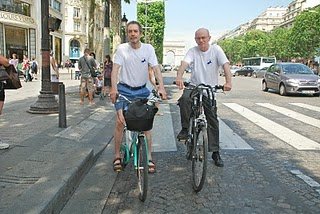
Early last spring, I was forwarded an email from an American man living in Paris who wanted to somehow combine handicapping and bicycle riding to raise money for retired thoroughbred racehorses.

The man, Alan Kennedy, said he had a friend, Mark Cramer, an author and bicyle enthusiast who had published both handicapping books and novels and who wanted to try out some of his methods at French racetracks, which he would reach by bicycle. Kennedy was going to accomplany him.

At the time, I was the first vice president of the Thoroughbred Retirement Foundation. My principle occupation for them was fundraising, and since it was a rare day when someone showed up and asked if they could help you raise money, I quickly said, `yes, thank you.’

Kennedy and Cramer prepare for their journey in Paris
Mark and Alan’s idea was that they would pedal a few hundred kilometers for the cause. What they didn’t know was that I may well be the world’s biggest Tour de France fan. I spend three weeks every July glued to the Versus network, catching the 8 a.m. preview, 8:30 - 11 a.m. live coverage, 2-5 p.m. recap and then the 8-11 p.m. recap...which is pretty much exactly like the 2-5 recap. I’m a little obsessed.

So I said, “You know what would really be the thing? To ride this tour during the dates of the real Tour de France, from July 3 to July 25. You could go from track to track in 21 stages, just like the riders go from town to town. People could pledge money per mile, or just make general donations.” They clearly thought I was crazy, but were also intrigued by the challenge, and wanted to do some good.

We decided that they could blog about it as they rode, and I would link the blog to a personal fundraising page that I would promote in the TDN. Putting aside fears of heart attack, heat stroke and general breakdown, they agreed to do it.

The result of this journey (aside from the thousands of dollars he raised for the TRF and a similar organization in France, La Ligue Pour la Protection de Cheval) is Cramer’s fantastic new book, Handicapping On the Road: Two men, 65 and 59, bicycle 1,000 kilometers to 13 race tracks to save discarded Thoroughbreds, testing seven exciting betting methods along the way.

The book is divided into two sections; the first, on the handicapping methods he features, and the second on the travelogue aspect and real-life betting stories of the trip. (Spoiler: he paid for the entire trip with his winning bets.)

Mark at Longchamp
The forward to the book is inspiring. Writes Cramer, “Using animals for entertainment and then sending them off to slaughter seemed as much an attack on our own humanity as it was the ultimate abuse of animals...Race fans feel rightful outrage and deep sadness when an equine athlete breaks down on the track. That’s because we see when it happens. But no one sees what happens to hard-knocking working-class Thoroughbreds when they disappear from the barns.”

The finish line at Compiegne
Cramer’s handicapping books are some of the most highly acclaimed in the industry. It has been a personal honor to come to know him and Alan, and I look forward to seeing them both in France this July, when we can watch the daily Tour coverage together over a nice glass of Bordeaux.

In the meantime, I highly recommend Handicapping on the Road, available here:
http://www.altiplanopublications.com/ontheroad.htm

Thursday, April 14, 2011

Me and A. P.

--Sue Finley

Much has been written about A.P. Indy this week; his incredible career at stud, how he revived the Bold Ruler sire line, and what an amazing racehorse he was.

I will always remember him best for the race he did not run.

Rhythmic gymnastics:
 one weird sport
In 1992, I was a researcher for ABC’s Wide World of Sports. Over the course of two years, I covered every sport imaginable, from synchronized swimming to rhythmic gymnastics. The tough part of the job was that in a matter of days, you had to make yourself into an expert on something you had barely heard of a week prior, in order to guide the producers and announcers through that week’s program. So every week started out something along the lines of, “I’m sorry...they’re actually going to perform the gymnastics with those clubs in their hands?” and by the end of the week, you’d be intelligently advising Frank Gifford to watch out for the proper opposite club rotation in the next pass.

I interviewed 128 12-year-old baseball players in a single afternoon and made notecards for Jim Palmer for that evening’s Little League World Series games (well, they claimed to be 12, anyway); I watched eight college football games at a single time and called out statistics to Roger Twibell at a second’s notice (“Ty Detmer: 52-yard TD pass, 8 completions, 243 yards!”) and I went to Cuba and reported on boxing at Kid Chocolate Hall.

Most of the time...I had no idea what I was talking about, which was a pretty disquieting feeling.

Which is why I loved major racing weeks. In 1991, we had gotten the rights to the American Championship Racing Series, and, combined with the Triple Crown, Triple Crown preps, and Travers, that gave me about 18 weeks a year when I actually felt really competent at my job.

Having worked in the NYRA Press Office for eight years, I pretty much knew every question they threw at me off the top of my head. Nick Zito’s mother’s name? Carmella. Wayne Lukas’s hometown? Antigo, Wisconsin. Richard Migliore’s wife? Also Carmella. In a world where these questions were fired at you seconds before Al Michaels would say them on the air...this was a very good thing.

For the seven days leading up to the Derby, I would prowl the backstretch with a camera crew, coming back with news and pre-taped items for the producer. And here’s a trade secret: much of what you see on air on a “live” telecast...really isn’t live.

Are those roses really growing in the Churchill infield...?
Those shots of the track with roses in the foreground? They were usually taped earlier in the day or earlier in the week by a cameraman and someone like me, who carried a dozen roses around all day to stick them in the shots and give the audience the feeling that Churchill Downs is covered in roses on Derby Day.

But one of my main jobs was to get a taped shot of every horse standing in his stall so that going to a commercial on the live Derby telecast, Jim McKay could say, “We’re just 53 minutes away...and there is Arazi...waiting in his stall...the moment at hand.”

But of course, no trainer wanted you in his horse’s face 53 minutes to post on Derby Day, so my job was to convince them that to take down their hay rack, clear the shedrow and let us roll a minute of tape was a good thing for them. And everyone agreed, and was happy to participate...except...

Monday, I went to A.P. Indy’s barn, and was told he was tied up to the back wall, and they didn’t want to disturb him so I should come back Tuesday. Tuesday, he was eating and shouldn’t be disturbed.

Wednesday, he was sleeping, and they didn’t want to wake him. Thursday, he was being done up. “I won’t shoot his legs,” I pleaded. “I just need him to stand at the front of the stall for 30 seconds or so with the hay rack down.” No dice.

A. P. Indy...out of his stall
 Friday, he was...I don’t know...doing something very important which precluded me from getting the stall shot.

So Saturday morning, back I went with the crew bright and early for one final shot at it.

“Neil,” I said, “I’m here to get the shot of A.P. Indy standing in his stall for the telecast today.”

Neil: “I’m holding a press conference at 8:30.”

Me: “I don’t need you to be here. I just need the shot of the horse in his stall.”

Neil: “I’m holding a press conference at 8:30.”

Maybe he didn’t hear me?

Me (a little louder): “I DON’T NEED YOU TO BE HERE. I JUST NEED THE SHOT OF THE HORSE IN HIS STALL.”

Neil (louder still): “I’M HOLDING A PRESS CONFERENCE AT 8:30.”

Me: “Ohhhhhhhhhhh.  You’re holding a press conference...”

I imagine I was the first person in the media to find out that A.P. Indy wouldn’t be running in the 1992 Kentucky Derby...my own little piece of history with one of the best racehorses and sires of a generation.

All because I couldn’t get a stall shot on Monday.

Tuesday, April 5, 2011

The RCI is Right

--Sue Finley

In my freshman English class at NYU, we were given an assignment to write a paper in which we had to take a position on something, and defend it.

Being a racing fanatic, I naturally chose to write a piece on why race-day medications should be banned for Thoroughbreds in North America. (Even at 18, I was a bunny hugger.)

Thirty years later (good God, I’m old) it’s nice to see that the Association of Racing Commissioners International agree with me. Last week, the RCI leaders called for a five-year phase out of of race-day medication, “to take the moral high ground and implement drug rules that mirror the racing in Australia, Dubai, Europe, Hong Kong and even Russia,” said new chairman William Koester.


My fellow students found the
use of race-day medications
horrifying.
 I was never sure why we wanted to cede the moral high ground in the first place. My first job was at NYRA, the last bastion of `hay, oats and water,’ and I was proud to show newbies around and tell them how loved and well-cared for the horses were, and how maybe in other states they were allowed to race on drugs, but they weren’t here.

Back in school, we had to read our position papers aloud in class, and I’ll never forget the expressions on the faces of the other students (none of them had had any exposure to racing) as I described the rising rate of not only breakdowns, but states which allowed medications to be given to racehorses in order to enable them to race through minor aches and pains, pulmonary bleeding, etc. Maybe I was leading the witnesses a little, but I’m going to bet you that it’s not a tough leap for the general public to go from injecting a horse with drugs on raceday to watching a horse break down in a race–whether that’s fair or not. In short, they were disgusted.

My argument then was the same as it is now: whether you think that it’s beneficial or harmful to horses, helpful/harmful to owner economics, increases/decreases field size, or any of the other arguments set forth to justify the use of medication in the racehorse, it is, if nothing else, terrible PR for our industry.

It was, therefore, refreshing to hear Koester, say, “Today over 99% of Thoroughbred racehorses and 70% of Standardbred racehorses have a needle stuck in them 4 hours before a race. That just does not pass the smell test with the public or anyone else except horse trainers who think it necessary to win a race. I'm sure the decision makers at the time meant well when these drugs were permitted, however this decision has forced our jurisdictions to juggle threshold levels as horsemen become more desperate to win races and has given horse racing a black eye.”

Koester is right. As a nation, we grow more compassionate to animals all the time. Smart businesses turn this sentiment to their advantage every day. Five years ago, I had to go to a health food store to find cage-free eggs. My local Acme now has five choices of free-range eggs, along with free-range organic-fed chicken breasts (and the Acme is about as far from a high-end market as it comes.)


300 stores and counting...
 To find a wider range of humanely raised meats (not that I’d eat them, but the family does), I drive a few miles to Whole Foods Market, which now operates more than 300 stores in North America and the UK. Partnering with the Global Animal Partnership, a non-profit dedicated to improving the lives of farm animals raised for their meat, Whole Foods’ stated mission is to offer “organic meats, raised humanely and processed with compassion.” Fifteen years ago, people would have laughed at that statement. Now, they’ll pay double for that meat because it makes them feel better about eating it.

Is it working? In the worst economy since the Great Depression, Whole Foods is projecting an earnings increase of 22.4% this year.

Let’s all side with the RCI on this one. Let’s take the moral high ground back, and let the public feel good about horse racing again.

Maybe our own 22.4% increase in sales will be just around the next corner.

Thursday, March 31, 2011

The Retirement `Solution'

--Sue Finley

Over the past two weeks, dozens of people have called, emailed or come to talk to me about the New York Times story on the Thoroughbred Retirement Foundation. As most of you are aware, I was on the board of the TRF for 12 years. As some of you may not know, I left the board last August for reasons which included differences of opinion with some board members, lack of time, and simple charity fatigue. After begging people for years to support this cause, I was simply worn out.

That doesn’t mean I don’t still support the cause, or don’t support the TRF, or don’t think you should still give your money to them. I do, on all counts. While I’m going to leave much of their own defense to the organization itself, as I have not been on the board for seven months now and am no longer versed in the daily goings-on, I will say that I’m pretty confident nobody at the TRF was starving horses for lack of money. They’re an incredibly dedicated bunch of individuals who have taken up a cause nobody else cared to do. If I had to guess, I’d say that it’s difficult to maintain hundreds of mostly 20-year-old racehorses over a long, hard winter, and that it’s impossible to expect that they’re all going to thrive out in a herd. Should some of them have been put down last fall? Probably. Is it hard for a ridiculously understaffed, underfunded organization to know that everyone on 13 farms is making the exact same decisions at every moment that they would make if they were there? I would imagine so. Did they make some mistakes? Absolutely.

Were they starving the horses for lack of funds? In no way do I believe that’s what has happened.

But the most troubling aspect of all this to me is people--good people, smart people, caring people–most likely overwhelmed when they look at the scope of the issue, are now suggesting a `solution’–that we should just humanely euthanize them at the end of their racing days if we can’t get them privately adopted. This isn’t a new theme--I’ve been hearing it for years–but it has grown in popularity of late.

It’s the only solution, they tell me. It’s humane, and it’s simple, and it solves the problem.

To anyone who thinks that’s a solution, I’d like you to do a little exercise. Think back to the first time you ever went to a racetrack. Maybe you were five, or 10, and your parents took you to Keeneland or Belmont or Newmarket (or Suffolk Downs, if you were me.) I know what I remember, and what attracted me to the sport. It was the horses. They were big and beautiful; majestic and inspiring creatures. I ascribed personalities to them (that they may or may not have had) and felt every bit as bad when they had setbacks as I did when the Red Sox lost to the Yankees. If I had asked someone then what happened to the horses when they were done racing, and they had said, “Well, we kill them...but we do it humanely,” I would have run screaming from the building, never to return, as I imagine you would have done.

So if you can’t admit to the world what your athletes’ pension plan is and be proud of it, I’m pretty sure this isn’t the retirement `solution’ racing needs to pursue. If we don’t want racing’s slogan to be, `the best cared-for and loved animals on the planet...until we don’t need them any more, at which time we kill them,’ let’s all aspire to better.

This can’t be left to charity any more. It’s time for an industry wide institutional funding mechanism that we can shout from the rooftops about. Because I’m pretty sure that if we can’t shout about it, there’s something wrong with it.

It’s time for all of the constituents in racing to sit down at the table and agree upon who is going to contribute what percentage from every mount, every start, every foal, every sale, every claim.

If you think we can’t afford it, you’re fooling yourselves.

We can’t afford not to.

Wednesday, March 23, 2011

Welcome to the new TDN Staff Blog

Today, we are introducing a new feature--The TDN Blog, where staff members and TDN contributors can share their thoughts on racing, breeding, industry travel, new racing books...or maybe the new great bar near Monmouth Park. In short, anything that touches their lives that might touch yours.

We thought it was a good opportunity to let you get to know them a little better. They're talented, witty, great writers, and are sure to entertain you with commentary that might not always be a good fit for the TDN, but is always sure to be a good read.

We hope you'll contribute as well by leaving comments, asking questions, or suggesting topics.

Enjoy!